


Inside Ukraine's Drone Defense Revolution
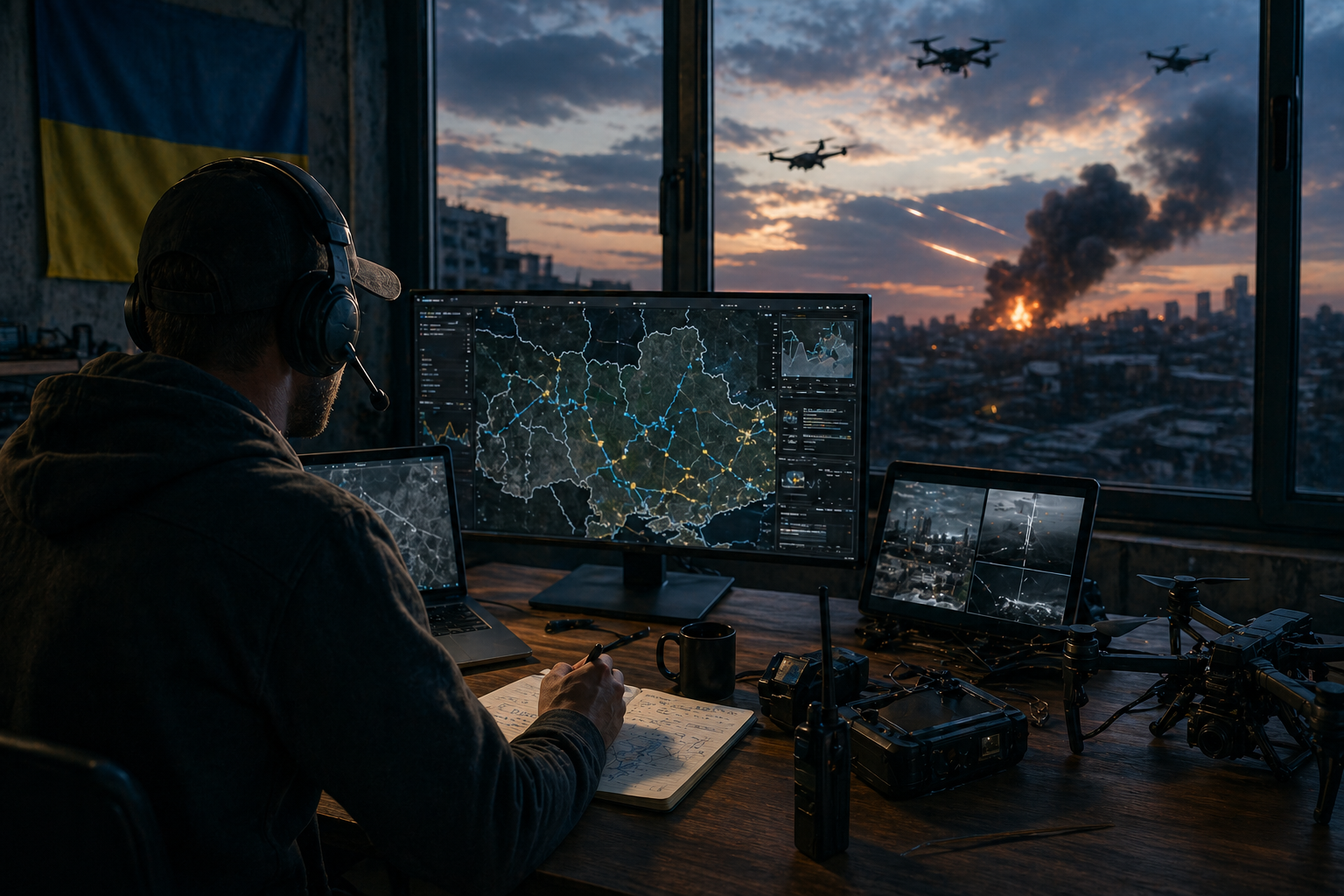
A Conversation with a Remote Support Specialist
Technology United for Ukraine sits down with a defense technology advisor who has been supporting Ukrainian initiatives from the United States since February 2022. With decades of experience in technical analysis and a network of contacts across Ukraine's military and non-profit sectors, they offer unique insights into how interceptor drones are reshaping modern warfare through the lens of remote analysis and information support.
TUFU: You've been supporting Ukrainian tech initiatives remotely since the full scale invasion began. How did that start for you?
I was up late finalizing on a project for work on 21 Feb 2022 when around 11pm EST one of my data feeds alerted me that Russian troops had crossed the border into Ukraine. I immediately woke my wife, who has family and friends in Ukraine, so she could reach out to them. I sent a message to my work saying I wouldn’t be coming in and we spent the next twelve hours or so helping navigate those family and friends away from and around the invading forces, using publicly available information and geospatial analysis, to locations deeper in Ukraine where they could stay with people in relative safety.
Having watched the months long buildup of hundreds of thousands of Russian troops on the border, it felt hopeless even while we saw acts of heroism and defiance cropping up all across the now occupied regions. We both continued to do what we could each day to help the Ukrainian people resist and stay safe but neither of us expected to still be doing this three and a half years later.
TUFU: From your remote analysis work, what makes these interceptor drones tactically revolutionary?
The data tells the story. I've been tracking intercept rates through publicly available information and reports from contacts on the ground. After Russia forces were halted by Ukrainian resolve and beaten back in areas such as around Kyiv, Russia began their campaign of terror. Around September of 2022 they began to supplement their missile strikes with cheap Iranian produced drones. In the beginning, Ukraine was burning through expensive missile interceptors, sometimes a half-million-dollar Patriot against these $30,000 drones. The model was unsustainable with Ukraine’s reeling economy and the trickle of western aid.
Now look at the cost comparison: Wild Hornets' Sting at $2,500 per unit, General Cherry's models around $1,000. When a Ukrainian unit reported downing a dozen Shaheds in one night using interceptors costing 30 times less than their targets, the strategic implications were clear. They've inverted the cost-asymmetry that Russia was banking on.
TUFU: How do you support these operations from the United States?
Primarily through terrain analysis and overlaying the emerging threat domes created by Russian systems to support frontline evacuations and return of children kidnapped, taken by Russian forces when their families were forced through filtration camps in the occupied areas. With the stagnation of the front lines these operations have taken a back seat to more kinetic defense of the, largely civilian, targets Russia strikes daily.
While I no longer am able to provide direct support I keep in touch with a variety of people working to out-innovate the Russian forces, helping where I can. When someone in Kharkiv discovers a new Russian drone tactic, I help to assess the threat and pass the info onto other contacts in various groups. It is all very fluid.
TUFU: You have described an incredible production scaling. How are they achieving this?
The distributed model is genius, and it's largely invisible to things like satellite imagery but is truly massive based on shipping data. Instead of centralized factories, which would be high value targets, they've created what I call a "production mesh." Not only are people producing components in home basements and old industrial buildings but the demand signal is managed by an innovative system that rewards platforms with higher rates of success by boosting orders.
They are using commercial components available on Amazon; flight controllers, motors, and batteries. When traditional supply chains failed, they improvised. 3D printing has proven a godsend for both bridging the gap between various component manufacturers and enabling rapid design iteration.
The numbers are staggering. General Cherry scaled from 100 monthly to thousands. Ukraine's goal of 1,000 daily interceptor deployments seemed impossible a year ago. But tracking their logistics and the new UK production partnership, it's becoming reality.
TUFU: You mentioned the UK partnership. How is Ukraine's innovation influencing global defense strategies?
Project Octopus is unprecedented, a NATO nation licensing Ukrainian battlefield innovation for domestic production. They are calling Ukrainian drone tech "world-leading," which is remarkable considering where Ukraine's defense industry was three years ago.
The ripple effects are measurable. At DSEI 2025, every major contractor showcased interceptor concepts. MARSS, Destinus, Cambridge Aerospace, they're all building on Ukrainian principles. Even tracking Russian defense exhibitions, you see them scrambling with their Yolka and Skvorets systems, essentially validating Ukraine's approach by copying it.
TUFU: How does the integration work from what you've observed through your analysis?
It's a networked system that's beautiful in its variety and redundancies. Through my geospatial work and conversations with operators, I've figured out the basic architecture. Detection happens through multiple layers, microphone arrays, radars, thermal sensors, even civilian spotter apps. This feeds into command systems like Delta.
The AI component is crucial. Many interceptors use SkyNode S modules that enable autonomous terminal guidance. I have seen reports of launching three interceptors simultaneously during a recent attack, letting their onboard AI sort out individual targets. No continuous control needed, even under jamming.
Others in my field of geospatial analysis provide help in optimizing this network, identifying radar shadows, optimal sensor placement, and intercept zones where geography naturally funnels incoming threats.
TUFU: With your data analysis background, how does Ukraine's adaptation speed compare to previous conflicts?
It's unprecedented. In previous conflicts, innovation cycles were measured in months or years. Ukraine iterates in weeks. I track this through technical reports where version 1.0 of an interceptor might have something like a 20% success rate, version 2.0 three weeks later hits 75%.
The feedback loop is incredibly tight. A soldier in Pokrovsk encounters a new Russian drone tactic on Monday. By Wednesday, engineers in Kyiv are modifying interceptor software. By Friday, the update is deployed nationally. This speed is only possible because of the distributed, networked approach they've adopted.
TUFU: What patterns do you see in the strategic impact?
The data paints a clear picture through intercept rates, attack patterns, and resource allocation. Ukraine has created an entirely new layer of air defense that didn't exist two years ago. This preserves their high-end systems for genuine strategic threats.
Ukrainian air defense can engage six Kinzhal hypersonic missiles precisely because they hadn't wasted Patriots on Shaheds. The interceptor drones, in conjunction with a variety of other methods, handled those.
But beyond military implications, Ukraine is pioneering autonomous systems with civilian applications, disaster response, infrastructure monitoring, search and rescue. The swarm coordination and AI they're developing will reshape multiple sectors globally.
TUFU: Any final thoughts from your remote support work?
Since February 2022, I've watched through reporting, data streams, and conversations with those on the front as Ukraine transformed from defending with antiquated Soviet systems to integrating western tech and now pioneering the future of warfare. Even from my desk in the States, I see innovation happening in real-time.
Every successful intercept represents saved lives, disproportionately civilian. Every production milestone means better protection for cities. Ukraine isn't just surviving, they're writing the playbook for 21st-century defense. And those of us supporting from afar, whether through analysis, funding, or information sharing, are witnessing history being made one intercepted drone at a time.